
Hardwood Flooring in McKinney, TX
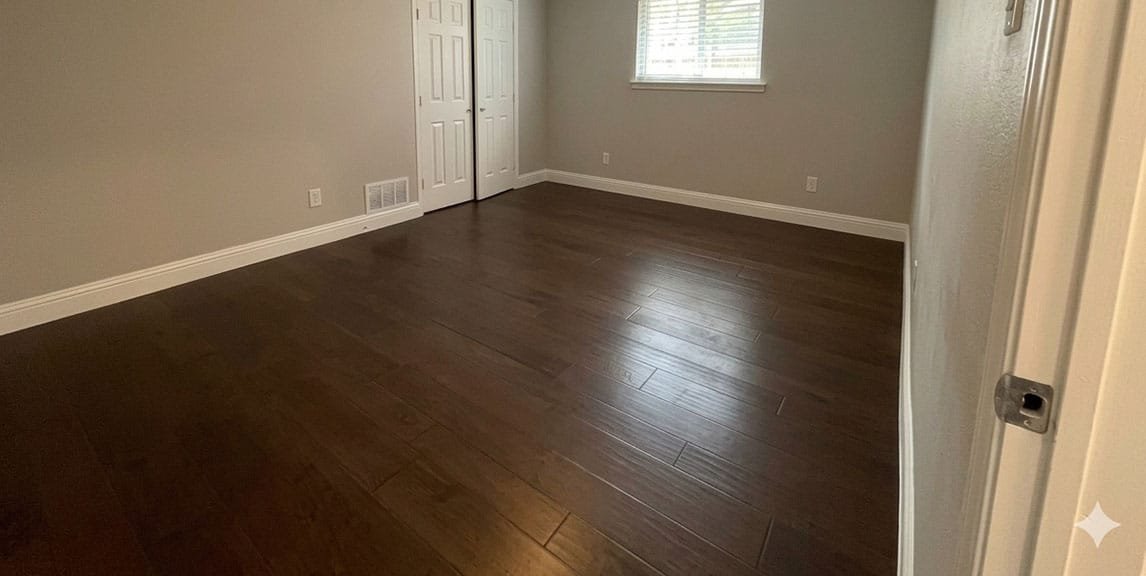
The builder put hardwood in the entry, the dining room and maybe the study. Everything else got carpet or tile. Now you want the wood to keep going: through the living room, down the hall, maybe up the stairs. The question everyone asks first is the right one. Can the new floor match the old one, or will you see the line forever?
Hardwood is widely used in homes across McKinney for its durability and classic appearance, and it can improve the overall character of a home. This page is about a common project in homes built in the 2000s: extending or matching a wood floor that is already there, plus what changes when the hardwood goes upstairs. For the fundamentals (solid vs engineered, species, finishes, North Texas humidity), see our hardwood flooring guide.
McKinney homes and the hardwood they already have
The median McKinney home was built in 2007, and about seven in ten were built in 2000 or later (U.S. Census Bureau, ACS 2020–2024 5-year estimates). If your home has hardwood in a few front rooms and carpet or tile in the rest, the original wood may now be worn in the traffic lanes. The carpet may be due too, and you may want one continuous floor.
There are three ways to get there, and choosing the right one is most of the decision.
| Approach | What it means | When it fits |
|---|---|---|
| Extend and blend | New boards of the same species, width and thickness woven into the old floor, then the whole area sanded and finished together | The existing floor is solid or thick-wear-layer engineered, and still in good shape |
| Replace everything | The old hardwood comes out and one new floor runs through all the rooms | The old floor is worn, thin, damaged, or not matchable |
| Deliberate break | The existing floor stays; a new, complementary floor starts at a natural boundary | Matching is not possible and replacement is not in the budget |
A blend means sanding and refinishing the floor you already have, so it is refinishing work as well as installation. Ask any contractor you talk to whether they do both. Replacing everything, or a new floor that starts at a deliberate break, is installation only.
Can the new floor match the old one?
It depends almost entirely on what the existing floor is. That is the first thing to check.
1. Is it solid or engineered? Pull a floor register or look at a stair edge or threshold. Solid boards show wood all the way through. Engineered boards show layers. Builder floors from the 2000s are often one or the other, and both can sometimes be extended.
2. Is it site-finished or prefinished? Prefinished boards have small bevels at every edge and a factory finish. Site-finished floors are flat and continuous.
- A site-finished floor is the easiest to extend: new boards go in raw, and the old and new are sanded and finished together.
- A prefinished floor can only be extended without a visible line with the same product, or a very close one, still in production. Factory colors and finishes change, and a “close” match next to a fifteen-year-old floor often looks wrong.
3. Species, width and thickness. Builder hardwood is often red oak or white oak in common widths. The new boards must match all three. Thickness matters because the two floors have to meet flush.
4. Wear-layer thickness, if engineered. Blending old and new usually means sanding. An engineered floor with a thin wear layer may not survive a full sand. If it cannot be sanded, extending it without a visible line is rarely possible.
The honest answer: a site-finished solid or thick engineered floor can usually be extended so the join disappears after finishing. A prefinished floor with a discontinued product usually cannot, and replacing it is often the better long-term value.
How a blended extension is done
This is how a blend is generally done, so you know what to ask about.
- Identify the species, width, thickness and construction of the existing boards.
- Source matching material in the same species and dimensions.
- Remove the old floor covering in the new rooms (carpet, pad and tack strip, or tile) and prepare the slab or subfloor.
- Weave the new boards in, staggering them into the existing floor at the doorway rather than leaving a straight seam. A few old boards are cut back so the new ones interlock.
- Sand the old and new together, so the surface is flat and both take stain the same way.
- Stain test patches on both old and new wood, in your light.
- Finish the whole area together. Even then, brand-new boards can look a shade different for a few months until they age toward the rest.
The objection: “Why would a blend mean sanding the existing floor too? It’s only in two rooms.” Because a new floor finished next to an old one rarely matches: the old finish has aged and worn. That is why a blend is refinishing work as well as installation, so ask any contractor whether it is in their quote.
Call (972) 746-1575 · Request an estimate
Hardwood after a wall comes out
Opening a kitchen to the living room, or removing a wall between a dining room and a study, leaves a strip of bare subfloor where the wall stood. Hardwood can usually be patched through that strip with woven boards, so the floor reads as if the wall was never there. If the wall is load-bearing, the structural work comes first; see load-bearing wall removal.
Hardwood upstairs
If your McKinney home has a second floor the builder carpeted, upstairs is actually an easier place for hardwood than downstairs. The reason is the subfloor.
| Downstairs (concrete slab) | Upstairs (plywood or OSB) | |
|---|---|---|
| Solid hardwood | Usually over a plywood subfloor added over the slab (a few solid products are approved for glue-down) | Can be nailed directly to the subfloor |
| Engineered hardwood | Glued down or floated | Nailed, stapled, glued or floated |
| Moisture concern | Slab moisture tested; barrier as needed | Much lower |
| Main concern | Flatness and moisture | Squeaks, flatness and sound to the room below |
Before hardwood goes upstairs:
- Fix squeaks first. Carpet hid them. Loose subfloor areas should be screwed down.
- Check flatness. Builder subfloors often have high seams that need sanding flat.
- Plan for sound. Hard floors upstairs carry footstep noise to the room below more than carpet. An underlayment approved by the manufacturer, plus rugs, reduces it.
- Decide the stairs early: new treads to match, or a runner. See staircase remodeling.
When hardwood is not the right extension
If the rooms you want to cover include a laundry room, a kids’ bathroom or a mudroom, hardwood is the wrong floor for those rooms, even if it runs right up to them. A complementary wood-look tile or luxury vinyl in a matching tone, starting at the doorway, keeps the look consistent and the wood dry.
Call (972) 746-1575 · Request an estimate
What drives the cost
- Extend or replace: weaving new boards into an existing floor, or a complete new floor.
- Matching material: common species and widths cost less to match than unusual ones.
- Removing carpet, tile or the old hardwood.
- Slab or subfloor preparation: moisture testing, leveling, squeak repair.
- Stairs, transitions and baseboards.
See our flooring installation cost guide. 0% financing is available for qualified homeowners.
Who installs your floor
- In-house design and construction
- Certified General Contractor
- $1 million in insurance coverage
- 500+ flooring and remodeling projects completed under Sami’s leadership
- Six-time Best of Plano award winner (2015, 2016, 2017, 2018, 2020, 2023)
- 60+ years combined experience
- Our installations include a written 1-year workmanship warranty
We serve McKinney from our Plano showroom at 2830 W. 15th St., Suite 1 (Mon–Fri 11–5, Sat 11–4). Bring a photo of a floor register opening or threshold edge to the showroom; it helps identify your existing floor.
Hardwood questions from McKinney homeowners
Can new hardwood match an existing floor exactly?
If your floor is prefinished and the same product is still made, new boards can be woven in as installation. A site-finished floor is matched by sanding and finishing old and new together, which is refinishing work: ask whether it is part of any quote you get.
How do I know if our floor is solid or engineered?
Look at the edge where a floor register sits, or at a stair nosing or threshold. Layers mean engineered.
Does the existing floor have to be sanded?
For a blend with no visible line, yes. The old and new floors are sanded and finished together. That is refinishing work on your existing floor, so ask whether it is part of any quote. Replacing the whole floor avoids it.
Can hardwood go upstairs over the existing subfloor?
Usually, yes. Solid hardwood can be nailed directly to a plywood or OSB subfloor once squeaks and high spots are fixed.
Will hardwood upstairs be noisy downstairs?
Louder than carpet. An approved underlayment and rugs help.
What if our old floor is too worn to blend?
Replacing it with one new floor through all the rooms is often better value than patching a floor near the end of its life.
More answers are on the flooring installation FAQ.
Get a hardwood estimate in McKinney
Tell us which rooms have hardwood now and which rooms you want it in. Ask whether your existing floor can be matched. We measure your rooms and give you a detailed written estimate for the options that fit.
Call (972) 746-1575 · Request an estimate
We typically respond within 24 hours.
Related: Hardwood flooring guide · Luxury vinyl in McKinney · Home remodeling in McKinney
Ready to Transform Your Home?
Connect With Us Today
Call or Text (972) 746-1575
The Flooring & Remodeling Shop
2830 W. 15th St. Ste. 1, Plano, TX 75075
Serving Plano & North Dallas Suburbs