
Hardwood Flooring in Murphy, TX
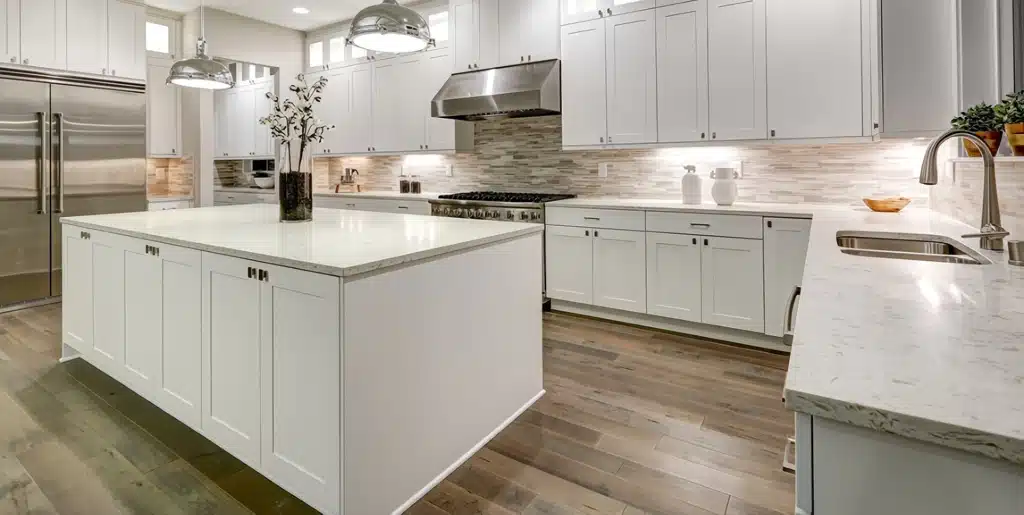
Many Murphy homes built in the 2000s came with hardwood in a few rooms, such as the entry, the dining room or a study, and carpet everywhere else. Twenty years on, owners usually want one of three things: to extend that wood into the living areas, to bring a tired floor back to life, or to replace it with something new. The Flooring & Remodeling Shop installs hardwood in Murphy and can look at your existing floor before you decide what to do with it. This page helps you work out which project you have.
Which hardwood project do you need?
| Your situation | Usually the answer |
|---|---|
| The finish is dull and lightly scratched, but the wood itself is sound | Screen and recoat: a light abrasion of the finish and a fresh topcoat, no sanding to bare wood |
| Deeper scratches, gray or worn traffic paths, or you want a new color | Full refinish: sanding to bare wood, staining if wanted, and new finish |
| You want hardwood in rooms that have carpet now | Extend the existing floor, then refinish everything together so it matches |
| Water damage, loose or cupped boards, or a worn-through engineered floor | Replace the affected area or the whole floor |
| You want a different look entirely (wider planks, another species) | New installation |
Murphy’s housing makes the extension question common: nearly two in three homes in Murphy were built between 2000 and 2009, and the median home was built in 2005 (U.S. Census Bureau, ACS 2020–2024 5-year estimates).
First, what floor do you actually have?
Many 2000s homes have floors that look like hardwood but are not, and the answer changes every option:
| Check | Solid hardwood | Engineered hardwood | Laminate or vinyl |
|---|---|---|---|
| Edge at a floor vent or threshold | One thick piece of wood | A real-wood top layer over plies or a core | A thin printed layer over fiberboard or vinyl |
| Pattern | Every board different | Every board different | Patterns repeat across the room |
| Sound | Solid | Solid if glued; slightly hollow if floated | Often hollow, or clicks underfoot |
| Refinishing | Yes, several times | Depends on the top-layer thickness | No |
If it turns out to be laminate or vinyl, refinishing is off the table. The choices become repair or replace.
Worn finish, or worn wood?
| What you see | What it usually means | Usual fix |
|---|---|---|
| Dull traffic paths, fine scratches, but the color is intact | The finish is worn; the wood is fine | Screen and recoat |
| Gray or bare-looking wood in traffic paths | The finish has worn through and the wood is exposed | Full sand and refinish |
| Deep scratches and dents | Damage into the wood | Full refinish; deep gouges may need board replacement |
| Dark or black stains | Water or pet urine has soaked into the wood. In oak, these stains often go too deep to sand out | Replace the affected boards, then refinish |
| Cupped or raised boards | Moisture problem, often from a leak or from below | Fix the moisture first, then repair or replace |
Can your floor be refinished?
It depends on what is there:
-
Solid hardwood can be sanded and refinished several times over its life.
-
Engineered hardwood can be sanded only if its top layer of real wood is thick enough. Thin-veneer engineered floors, common in builder installations, may allow one light sanding or none. The thickness can be checked at a floor vent or a threshold before deciding.
-
Prefinished floors with beveled edges can be refinished, but sanding flat removes the bevels unless the floor is only recoated.
If a floor has already been sanded several times, or the veneer is too thin, replacing it is the honest answer.
When a recoat will not stick
A screen and recoat only works if the new coat can bond to the old one. Two things commonly prevent that:
-
Polish and “refresher” products used over the years can leave a residue that new finish will not adhere to;
-
Some very hard factory finishes on prefinished floors resist new coats unless the surface is specially prepared.
A small test area is coated first to confirm adhesion before the whole floor is done. If the test fails, the choice is a full sanding or living with the current finish.
What a full refinish involves
A full refinish means sanding to bare wood, optional staining, and several finish coats, with the rooms off-limits while the finish cures.
Extending an existing hardwood floor
Running the wood into the living room or down a hallway is one of the most common Murphy projects. To make old and new look like one floor:
- Identify the existing floor: species, board width, thickness, and solid or engineered.
- Match it. New boards of the same species and width are woven into the old floor at the doorway, board by board, rather than butting against it in a straight line.
- Refinish the whole area together. New wood and 20-year-old wood will not match in color until both are sanded and finished at the same time. If the existing floor is prefinished engineered wood and the product is discontinued, matching may not be possible, and replacing the whole connected area is often the better choice.
Choosing new hardwood
-
Solid hardwood: nailed to a wood subfloor, refinishable many times, and moves more with humidity.
-
Engineered hardwood: a real-wood top layer on a stable core. It can be glued or floated over concrete, which suits slab homes. Choose a thicker wear layer if you want to refinish it later.
-
Prefinished or site-finished: prefinished installs faster and cleaner; site-finished gives a custom color and a continuous surface, and is the way to match new boards to an existing floor.
For the trade-offs between wood and its alternatives, see wood-look tile in Murphy, our hardwood vs. luxury vinyl plank comparison and our guide to the most durable kitchen flooring.
Caring for hardwood in a family home
-
Felt pads under chairs and furniture, and mats at exterior doors.
-
A damp, not wet, mop with a cleaner made for the finish. Avoid steam mops.
-
Keep indoor humidity steady. The National Wood Flooring Association’s general guide is 30–50% relative humidity.
-
A screen and recoat every few years in busy rooms, before the finish wears through, extends the time between full refinishes.
What drives the cost
| Project | Main cost factors |
|---|---|
| Screen and recoat | Floor area, adhesion testing, number of coats |
| Full refinish | Floor area, the depth of damage, stain, finish type and coats, and stairs |
| Board replacement | How many boards, matching the species and width, and refinishing the area so it blends |
| Extending into new rooms | Removing the old floor, matching boards, weaving them in, and refinishing everything together |
| New installation | Product, installation method, slab preparation and the area covered |
For general flooring cost factors, see our flooring installation cost guide.
Who does the work
-
In-house design and construction team
-
Certified General Contractor
-
$1 million in insurance coverage
-
500+ flooring and remodeling projects completed under Sami’s leadership
-
Six-time Best of Plano award winner (2015, 2016, 2017, 2018, 2020, 2023)
-
0% financing available for qualified homeowners
Hardwood samples are at our showroom, 2830 W. 15th St., Suite 1, Plano (Mon–Fri 11–5, Sat 11–4).
Hardwood questions from Murphy homeowners
How do I know if my floor is real hardwood?
Look at the edge at a floor vent or threshold. Real wood shows wood through its thickness, or a wood layer over plies; laminate shows a thin printed layer over fiberboard. Repeating patterns are another giveaway.
Can black pet stains be sanded out?
Often not. Urine reacts with the wood and stains deep into the board, especially in oak. The usual fix is replacing those boards and refinishing the area.
Why would a recoat fail?
Usually because polish or refresher products left a residue, or because a hard factory finish was not prepared properly. A test patch checks adhesion first.
Can new hardwood match our existing floor?
Usually, if the species and board width can be matched and both floors are sanded and finished together. Prefinished engineered floors are the hardest to match.
What is a screen and recoat?
A light abrasion of the existing finish followed by a new coat. It refreshes a floor that is dull but not worn through, without sanding to bare wood.
How do I know if my engineered floor can be sanded?
By the thickness of its real-wood top layer, which can be checked at a vent or threshold. Thin veneers may not survive a full sanding.
Do we have to move out during a refinish?
Not usually, but the rooms being finished are off-limits until the finish cures, and some finishes have an odor. The work should be sequenced room by room so the household can keep using the rest of the home.
Is a permit needed for new hardwood in Murphy?
The City of Murphy treats flooring as cosmetic work that does not require a permit (City of Murphy). Your HOA may still have rules for contractors and work hours.
What does hardwood installation or refinishing cost?
The area, the species, matching to an existing floor and the type of finish are the main factors. See our flooring installation cost guide and the flooring installation FAQ.
Get a hardwood estimate in Murphy
Tell us what is on your floors now and what you want to change. We will look at the existing floor, talk through the options on this page and give you a detailed written estimate.
Call (972) 746-1575 · Request an estimate
Related: Wood-look tile in Murphy · Flooring installation · Flooring installation cost · Flooring installation FAQ · Hardwood vs. luxury vinyl plank
Ready to Transform Your Home?
Connect With Us Today
Call or Text (972) 746-1575
The Flooring & Remodeling Shop
2830 W. 15th St. Ste. 1, Plano, TX 75075
Serving Plano & North Dallas Suburbs