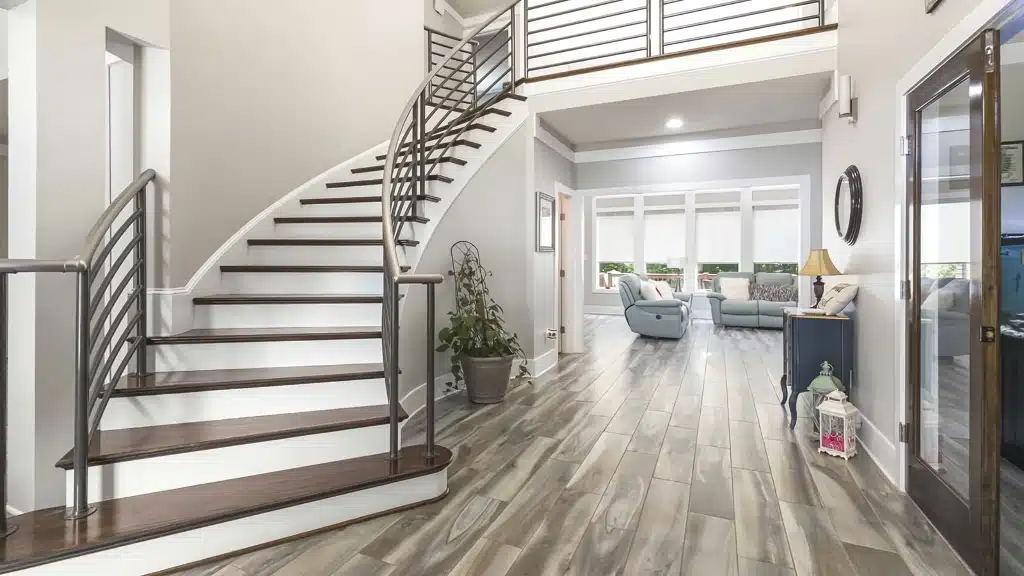
A stairway remodeling project can completely change the look and feel of your home’s entry. Many homeowners choose staircase remodeling services to update outdated carpeted stairs, improve their home’s design, and create a more cohesive look with their flooring.
This guide covers the most popular staircase remodel options for homeowners in Plano, Frisco, Allen, McKinney, and surrounding communities, from material choices to design styles.
The Transformation Potential
Staircase remodels are also among the most efficient home improvements in terms of disruption. Most staircase projects can be completed in a matter of days, not weeks, with minimal impact on the rest of your home.
Carpet-to-Hardwood Staircase Conversion
The single most popular staircase remodeling project across North Dallas is removing carpet and installing hardwood treads. Thousands of homes in Plano, Frisco, McKinney, and Allen were built with carpeted staircases that have since worn, stained, or simply fallen out of style.
What the Conversion Involves
Removing carpet from stairs reveals the underlying tread structure, which is typically made of construction-grade plywood or pine. These materials are not meant to be seen and are not suitable as finished surfaces.
The conversion process involves:
- Removing the existing carpet, padding, and tack strips. All staples and adhesive residue are cleaned from the surface.
- Preparing the substrate. The existing treads are evaluated for structural soundness. Any squeaks, loose treads, or structural issues are addressed.
- Installing hardwood tread caps or replacement treads. Hardwood tread caps are precision-cut pieces of solid hardwood that are fitted over the existing tread, creating a clean, finished wood surface. In some cases, the existing treads are removed entirely and replaced with solid hardwood treads.
- Finishing the risers. Risers (the vertical faces between each step) are typically painted white or a complementary color. Some homeowners prefer stained risers to match the treads for a more uniform look.
- Installing a return nosing. The nosing is the front edge of the tread that overhangs the riser. A properly shaped and finished nosing gives each step a polished, professional appearance.
Matching Your Existing Floors
One of the most important aspects of a staircase conversion is matching the hardwood treads to the flooring on the upper and lower levels. When the stairs connect hardwood floors on multiple levels, the species, stain color, and finish should coordinate seamlessly.
Our team at The Flooring & Remodeling Shop carefully matches staircase treads to your existing hardwood flooring to ensure a cohesive look from floor to floor.
Material Options for Staircase Treads
The material you choose for your stair treads affects both the look and performance of your staircase.
Oak
Red and white oak are the most common choices for staircase treads in North Texas homes. Oak is hard, durable, and takes stain well. White oak, in particular, has become increasingly popular for its subtle grain pattern and compatibility with modern and transitional design styles. Oak remains a popular choice for homeowners updating their floors because of its durability, timeless appearance, and ability to coordinate with many flooring styles.
Hickory
Hickory is one of the hardest domestic wood species, making it extremely durable for high-traffic staircases. It features a pronounced, rustic grain pattern with natural color variation that works well in casual, farmhouse, and transitional settings.
Maple
Maple offers a clean, uniform grain with a lighter natural color. It is well-suited to contemporary and minimalist designs where a smooth, consistent appearance is desired.
Engineered Hardwood Treads
Engineered hardwood treads are made from a real wood veneer bonded to a stable plywood core. They offer the beauty of real wood with enhanced dimensional stability, which can be advantageous in the variable humidity conditions common in North Dallas.
When to Choose Hardwood
Iron Balusters
Replacing wood balusters with iron balusters is one of the most popular staircase upgrades in the DFW area. Iron balusters are available in a wide range of designs:
- Plain square or round bars deliver a clean, modern look
- Single and double twist patterns add traditional elegance
- Basket and scroll designs create a more ornate, classic feel
- Hammered or forged textures add character and visual weight
Iron balusters are typically finished in satin black, oil-rubbed bronze, or antique nickel. They pair beautifully with both stained and painted handrails and with virtually any tread material.
Cable Railing
Cable railing systems use horizontal stainless steel cables stretched between posts in place of traditional balusters. This creates an open, airy look that is popular in contemporary and modern homes. Cable railing maximizes sightlines and allows light to pass through the staircase, which can make an entryway feel more spacious.
Wood Balusters
Updated wood balusters remain a good choice for traditional, colonial, and craftsman-style homes. Modern wood baluster profiles are available in both simple and detailed designs, and they can be painted or stained to complement the rest of the staircase.
Handrails
The handrail ties the baluster system together. Options include:
- Stained wood handrails that match the tread species and color
- Painted wood handrails (typically white) for a crisp, contrasting look
- Metal handrails in black or brushed finishes for a contemporary aesthetic
Open vs. Closed Staircase Design
The structural style of your staircase, whether open or closed, significantly affects the room’s feel.
Closed Staircases
A closed staircase has walls on both sides. This is common in hallways and interior locations where the staircase is tucked between rooms. Closed staircases can feel narrow and dark, but they also offer opportunities for wainscoting, board and batten, or other wall treatments that add character.
Open Staircases
An open staircase has one or both sides exposed to the room, with balusters and a railing instead of a wall. Open staircases feel more connected to the surrounding space and are the focal point of many North Dallas home entryways.
If your home has a closed staircase that you would like to open up, this is possible in many cases. Opening a staircase involves removing the knee wall or full wall on one side and installing a railing system. This can dramatically change the look of your entry and the flow between floors.
Remodeling projects that involve structural changes may also require permits and inspections, depending on the scope of the work. Homeowners can review the City of Plano building and permitting information for local requirements.
Floating Staircase Elements
For a more contemporary statement, some homeowners opt for floating treads, where each tread appears to extend from the wall without visible support beneath. This creates a light, sculptural look that serves as a design centerpiece. Floating staircase designs require specific structural engineering and are best suited to new construction or major renovations.
Painted Risers and Decorative Details
Beyond the treads and balusters, the risers and surrounding trim offer additional opportunities to personalize your staircase.
- Painted white risers with stained treads is the most popular combination in our market. The contrast between dark treads and bright white risers creates a clean, classic look that works in nearly any home style.
- Stained risers that match the treads create a more uniform, rich look. This is common in formal or traditional settings.
- Decorative trim along the stair stringers (the angled boards that support the treads on each side) can add a finished, custom look, especially on open staircases visible from the main living area.
How a Staircase Remodel Connects to Your Flooring
Your staircase is a bridge between the flooring on different levels of your home. A staircase remodel often goes hand-in-hand with a flooring update, and coordinating the two projects ensures a seamless result.
When you update your main-level floors to hardwood or LVP, the staircase should complement that material. Similarly, if you are updating upper-level flooring, the staircase serves as the visual transition between levels.
Many of our clients in Plano, Frisco, and McKinney choose to update their staircases at the same time as their flooring installation. This allows us to match species, stain colors, and finishes precisely, and it reduces the overall disruption compared to doing the projects separately.
Start Your Staircase Transformation
Your staircase does not have to be an afterthought. A well-executed staircase remodel transforms your home’s entryway and connects beautifully to the rest of your updated spaces.
The Flooring & Remodeling Shop provides staircase remodeling services throughout Plano, Frisco, Allen, McKinney, Celina, Prosper, and Richardson. From carpet-to-hardwood conversions to full baluster and railing replacements, we handle every detail.
Call us at (972) 746-1575 or schedule a free consultation to discuss your staircase project.