
Wood Tile Flooring in Frisco, TX
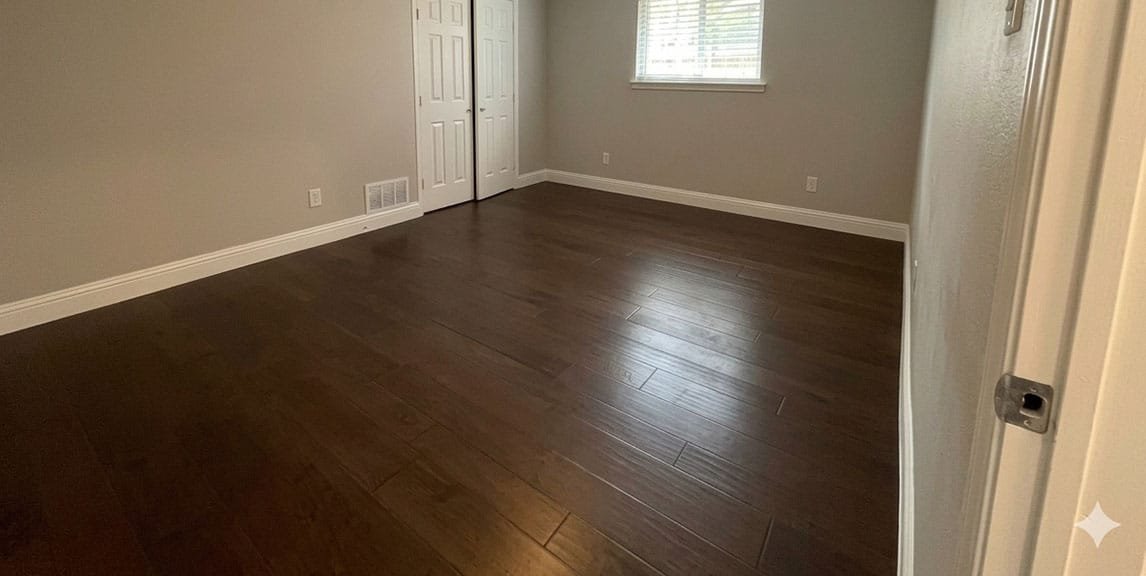
You saw it in a restaurant entry, or on a feed you scroll every night: a wood-look floor laid in a tight herringbone, running from the front door straight through the house. It looked expensive, in a good way. The question is whether it will look the same in your entry, how much more it costs than a straight lay, and where in the house a pattern belongs.
Wood-look tile is a practical floor for a Frisco home: it resembles hardwood with the durability of porcelain, in kitchens, living areas and busy entries. After choosing the tile, one of the biggest design decisions is the pattern it is laid in. A straight plank layout reads like a classic wood floor; herringbone and chevron turn the floor into a feature. Patterns change how much tile is cut, how much is wasted, how long it takes and how the room feels. This page compares them.
For the product basics and the layout rules for a straight lay, see our wood-look tile guide.
Laying patterns compared
| Pattern | Look | Suits | Cutting and waste | Notes |
|---|---|---|---|---|
| Random stagger | Most like a real wood floor | Whole-house, open plans | Lowest | End joints are spread so no pattern lines up. Long planks follow the industry’s offset limit (commonly no more than one-third of the plank length) unless the manufacturer allows more. |
| Regular offset (1/3) | Orderly, consistent | Large open areas | Low | A predictable stair-step pattern; very flat results with long planks |
| Herringbone | Classic, high-end | Entries, dining rooms, a feature zone | Higher | Short planks set at right angles in a zigzag; often needs a herringbone-specific tile size |
| Chevron | Modern, directional | Hallways, feature areas | Highest | Planks with angled ends meet in a continuous point; usually a dedicated chevron tile |
| Mixed widths | Rustic, custom-floor look | Living areas, farmhouse styles | Moderate | Two or three plank widths combined in a repeating sequence |
Pattern also sets direction. A herringbone or chevron “points” somewhere, usually along the length of the room, or from the entry toward the main living space. Decide it before the first tile is set.
Planning a patterned floor
- Start from a centerline. Herringbone and chevron are laid out from a center line so the pattern is symmetrical in the room and in doorways, not from whichever wall is closest.
- Decide where the pattern stops. A feature pattern in the entry or dining room can be framed with a border and switch to a straight lay in the rest of the house. Plan the transition so it lands at a natural break.
- Order more tile. Patterned layouts produce more cut pieces and more waste than a straight lay, so order extra material, all from the same production lot so the shade matches.
- Expect more labor. Every perimeter piece in a herringbone floor is a custom cut. The pattern adds time even when the tile is the same.
- Check the tile is made for it. Some collections offer herringbone or chevron formats, or sizes intended for them. Cutting standard planks to create a pattern can work, but it adds cuts and edge-finishing.
Making any pattern look right
Whatever the pattern, wood-look tile needs a flat slab, full mortar coverage and grout joints sized to the tile. Our Murphy wood-tile page explains those rules. In an open-plan home, one consistent pattern through connected spaces usually looks most natural. Eight in ten Frisco homes were built in 2000 or later (U.S. Census Bureau, ACS 2020–2024 5-year estimates). If yours has an open kitchen and family room, choose the pattern for the whole connected space, not room by room.
Call (972) 746-1575 · Request an estimate
How a Frisco wood-tile installation runs
- Design: pattern, direction, borders and where patterns change.
- Measurements and material order: including the extra the pattern needs, all from one lot.
- Preparation: old floor out, slab ground and leveled, crack isolation where needed.
- Layout: center lines snapped and the pattern planned before setting.
- Setting, grouting, movement joints and trims.
Planning a pattern around furniture and rugs
A pattern is only as good as what is left visible:
- Sketch the furniture first. A herringbone hidden under a sectional and a large rug wastes the effort.
- Put feature patterns where they are seen: entries, dining rooms and hallways.
- Center patterns on what the eye sees first, such as the front door or a fireplace, not just the room’s geometry.
- Keep rug sizes in mind: a large rug over a patterned floor can look busy; a straight lay is calmer under rugs.
What a patterned tile floor costs depends on
- The pattern: herringbone and chevron take far more cutting and labor than a straight lay;
- Whether the tile is made in a pattern format or cut from standard planks;
- Extra material for the pattern’s waste;
- Borders and the transitions where patterns change;
- Slab preparation and the number of doorways.
Call (972) 746-1575 · Request an estimate
Who does the work
- In-house design and construction
- Certified General Contractor
- $1 million in insurance coverage
- 500+ flooring and remodeling projects completed under Sami’s leadership
- Six-time Best of Plano award winner (2015, 2016, 2017, 2018, 2020, 2023)
- 60+ years combined experience
- Our installations include a written 1-year workmanship warranty
- 0% financing available for qualified homeowners
See plank and pattern tiles at our showroom, 2830 W. 15th St., Suite 1, Plano (Mon–Fri 11–5, Sat 11–4).
Wood-look tile questions from Frisco homeowners
Should we put herringbone under the dining table?
You can center a herringbone on the dining area, where it frames the table. Avoid hiding a feature pattern under large rugs or sofas.
Does herringbone tile cost more?
Usually yes: more cutting, more labor and more waste than a straight lay, even with the same tile.
Can we do herringbone in just one area?
Yes. A herringbone entry or dining room framed by a border, with a straight lay elsewhere, is one way to do it.
Which direction should the planks run?
Usually along the longest dimension of the main space, or toward the main entry. Patterns are aimed from a center line.
Will a patterned floor make a small room look busy?
It can. In small rooms, a simple random stagger or a larger herringbone module often looks calmer.
How much more does herringbone cost than a straight lay?
Noticeably more labor and extra material for waste. It depends on the room shape and whether the tile is made in a herringbone format. Ask for each option to be priced on your written estimate. See the flooring installation cost guide.
Get a wood-look tile estimate in Frisco
Send us your floor plan and a photo of the pattern you like. We will measure and give you a detailed written estimate for the pattern you choose.
Call (972) 746-1575 · Request an estimate
We typically respond within 24 hours.
Related: Wood-look tile in Murphy · Hardwood flooring in Frisco · Luxury vinyl flooring in Frisco · Wood-look tile guide
Ready to Transform Your Home?
Connect With Us Today
Call or Text (972) 746-1575
The Flooring & Remodeling Shop
2830 W. 15th St. Ste. 1, Plano, TX 75075
Serving Plano & North Dallas Suburbs