
Hardwood Flooring Installation in Dallas, TX
You lifted a corner of carpet in a closet and found narrow oak boards. Or your house sits on a slab and you want real wood for the first time. Or you own a condo, and the association has rules about hard floors that you have never read. In Dallas, all three are common. Each one changes how hardwood should go in.
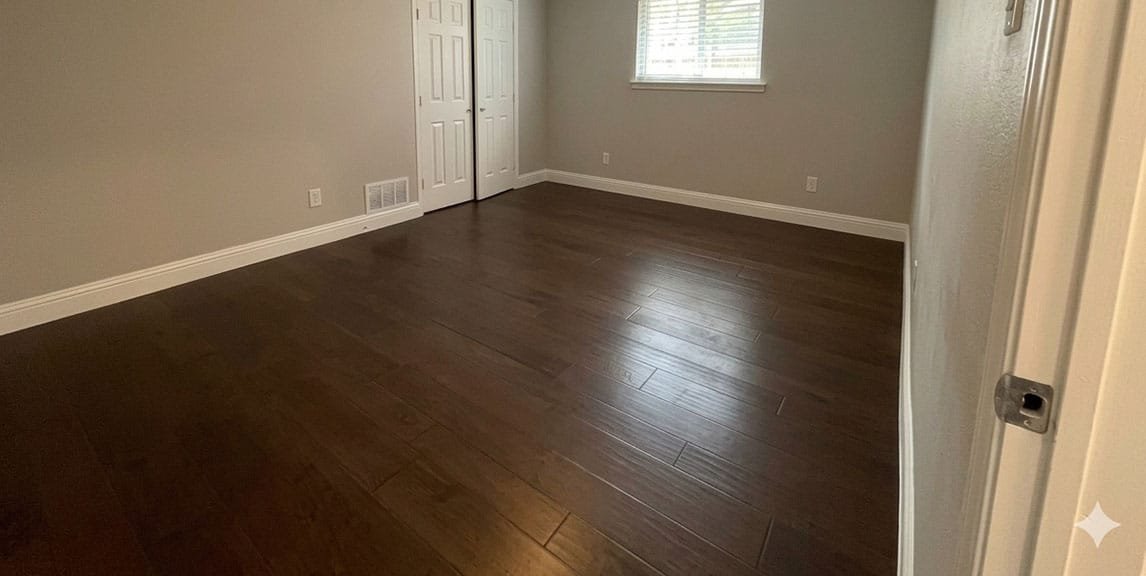
Hardwood flooring remains a preferred option for many homeowners in Dallas who want durable flooring with a natural wood appearance. Proper installation ensures the flooring remains stable and maintains its appearance over time. The Flooring & Remodeling Shop provides hardwood flooring installation services for homeowners throughout Dallas who are looking to update older flooring with natural wood materials. We take out the old floor, check what is underneath, install solid or engineered hardwood by the method your product calls for, and finish the stairs, transitions and trim.
By Dallas, we mean the City of Dallas itself. That includes North Dallas, the northern part of the city, generally the areas north of Northwest Highway reaching past LBJ Freeway (I-635) into Far North Dallas. We serve the city from our showroom in Plano, at 2830 W. 15th St., Suite 1.
Start with what your floor sits on
Dallas housing covers a wide span of ages and types. The median home in the city was built in 1981, and about one in three was built before 1970. Only about four in ten homes are detached single-family houses. The rest are townhomes, condos, apartments and other attached or multi-unit buildings (U.S. Census Bureau, American Community Survey 2020–2024 5-year estimates).
So before anyone talks about species or color, the first question is simple. What is under your floor?
| If your home is… | What is usually underneath | What new hardwood usually means |
|---|---|---|
| An older house with a crawl space (pier-and-beam) | Wood joists and a wood subfloor. Sometimes original wood under the carpet | Solid or engineered hardwood nailed to the wood subfloor, after squeaks, bounce and flatness are dealt with. Or the original floor is kept, if it is worth saving |
| A house on a concrete slab | Concrete, with carpet, tile or vinyl on top | Engineered hardwood glued down or floated after a moisture test, or solid hardwood over a plywood subfloor. Some solid products are approved for glue-down |
| A condo or stacked townhome | Often a concrete deck shared with the unit below | Often engineered hardwood over an underlayment that meets the association’s sound rule, with the height checked at the entry door |
Not sure which you have? Look outside for foundation vents or a crawl-space access door low on the walls. Inside, a floor register or a threshold is the easiest place to see what is under the carpet.
Found hardwood under the carpet? How to tell if it is worth keeping
“It looks terrible. How can that be worth saving?” A floor that looks ruined under old carpet can still be sound wood with a worn finish. Old finish and surface stains mostly sand off; deep pet stains and rot do not. What matters is the wood itself. These questions decide it:
| Question | Keep it if… | Replace it if… |
|---|---|---|
| How much wood is left above the tongue? | Enough to sand. Solid strip floors usually have several sandings in them | It has been sanded thin, with nail heads or tongues showing |
| Is it solid or a thin veneer? | Solid | A veneer too thin to sand |
| How much damage? | Scattered stains and scratches | Large areas of rot, deep pet stains or water-buckled boards |
| Is it flat and tight? | Mostly flat, with minor gaps | Sloping, bouncing or badly cupped (find the cause first) |
| Does it run where you want wood? | Through the rooms you want | Only in a few rooms, with no practical way to extend it |
Keeping it means refinishing, and that is a different job from installation. We refinish parquet floors. If you have solid, well-bonded parquet, refinishing can save it. For a strip or plank floor, call (972) 746-1575 and describe what you found. We will tell you whether refinishing or a new floor makes more sense.
When it cannot stay, you have two routes. The old boards come up and new hardwood goes on the subfloor. Or, in some cases, new wood goes over the old floor. Wood-flooring guidelines allow that only when the old floor is flat, sound and well fastened. Old and new wood also have to be close in moisture content: within 4% for strip flooring and 2% for wider plank, per the National Wood Flooring Association. It also raises the floor, so doors and transitions have to allow for it.
Call (972) 746-1575 · Request a written estimate
Pier-and-beam floors: fix what is underneath first
Some older Dallas houses sit on piers and beams, with wood joists over a crawl space, instead of a slab. If yours does, the floor can squeak, bounce or slope as the house settles and fasteners loosen. A new hardwood floor does not cure any of that. It sits on top of it.
Why it happens, and what fixes it:
- Squeaks usually come from a subfloor that has worked loose from the joists. Fastening it back down stops the movement, and the noise with it.
- Bounce or sag can mean undersized or damaged joists, or piers that have settled. That is a structural question. Have it evaluated and resolved before any new floor goes down.
- Moisture from below reaches a wood floor through the crawl space. The NWFA’s installation guidelines call for at least 18 inches between the ground and the underside of the joists. They also call for the exposed ground to be covered with a vapor retarder, or the space ventilated as building codes require (NWFA).
- Board direction matters. Hardwood is normally laid across the joists. If your layout needs it to run the same way as the joists, the guidelines call for a second layer of plywood on the subfloor, or bracing between the joists.
“Can’t we put the floor down now and fix the squeaks later?” Some squeaks can be reached later from the crawl space. Bounce and slope cannot be fixed by a floor, and wood laid over a moving subfloor works loose itself. Before installation, we check the subfloor for flatness, squeaks, moisture concerns and damage, so you know what you are building on.
New hardwood on a Dallas slab
If your house sits on concrete, nails have nothing to grip. That shapes the choice of floor.
- Engineered hardwood has a real-wood top layer over a stable core. Depending on the product, it is glued to the prepared slab or floated over it. It sits lower and moves less with the seasons.
- Solid hardwood is usually nailed to a plywood subfloor fastened over the slab. It feels solid underfoot, but it raises the floor, so doors, transitions and the bottom stair have to allow for it. A few solid products are approved by their manufacturer for glue-down directly to the slab.
Moisture comes first, whichever you choose. Concrete always holds some moisture. The NWFA and wood-floor manufacturers require it to be checked before wood goes over it. The readings decide whether a moisture barrier or a moisture-control adhesive is needed. An older slab may not have the vapor retarder that is standard under newer ones, which makes the test more important, not less.
Cracks and dips. Thin shrinkage cracks are common in slabs. Wider cracks, cracks where one side sits higher, and dips are filled, ground or leveled to the flatness the flooring manufacturer requires. A crack that keeps widening or shifting can point to foundation movement. Have that evaluated before any new floor goes down.
Call (972) 746-1575 · Request a written estimate
Hardwood in a Dallas condo or townhome
If someone lives below you, your floor is their ceiling. That is why many associations regulate hard floors. Get the rules in writing before you choose a product, and look for these:
| Rule | What it means for hardwood |
|---|---|
| A minimum sound rating (impact, IIC; sometimes airborne, STC) | The rating applies to the whole assembly: wood, underlayment and the building’s floor. The product’s published test with a specific underlayment has to meet it |
| A required or approved underlayment | Use that one, or one with an equal or better tested rating |
| Approval before work starts | Often with the product and underlayment data sheets attached |
| Hard floors limited to certain rooms | Some buildings require carpet in bedrooms |
| Work hours, elevator reservations, debris removal | Planned before the start date |
“Nobody checks.” Until the neighbor below complains. A floor that breaks the rules can be ordered out at the owner’s cost.
Two more condo checks. A concrete deck in an older building can have humps, dips and old adhesive ridges, so it is checked for flatness and moisture like any slab. And the entry door, the hallway outside and your floor inside often sit at fixed heights. The new floor’s total height, wood plus underlayment, has to work at that door. Your written estimate spells out the materials, so you have the product details your association asks for.
Old layers, parquet and patched floors
Older homes collect floors. Before anything comes up, it helps to know what you are dealing with.
- Carpet, pad and tack strip come up quickly. The strip nails are pulled and the holes filled so the new wood sits flat.
- Ceramic tile comes up with its mortar, and the slab is ground flat again. It is the most labor-intensive removal, so it is priced separately in your estimate.
- Sheet vinyl or vinyl tile. In homes built before the 1980s, vinyl flooring and the black adhesive under it can contain asbestos. The U.S. EPA advises leaving undamaged material alone. If yours might contain it, have it tested by a qualified inspector before anyone disturbs it (EPA).
- Parquet, small wood blocks glued down, turns up in some older homes and condos. If yours is solid and well bonded, we can refinish it instead of tearing it out. Loose or water-stained blocks come up, and the old adhesive is removed before the new floor goes down.
Patching or extending an older wood floor. When a wall comes out or a few boards are ruined, new boards can be woven into the old floor instead of butted at a straight seam. Older floors often use widths and thicknesses that are no longer standard, so the match may need boards milled to size or reclaimed wood. A blend with no visible line means sanding and finishing old and new together, which is refinishing work on your existing floor. Replacing the whole floor avoids it.
Call (972) 746-1575 · Request a written estimate
How a Dallas hardwood project runs
- A consultation in your home, or at our Plano showroom, where you can compare full-size samples.
- Measuring and inspection: every room, step and doorway, plus the slab or subfloor, and the crawl space if you have one.
- A detailed written estimate that spells out removal, preparation, materials, stairs and transitions.
- Acclimation of the wood in your conditioned home, following the manufacturer’s instructions, so it does not shrink into gaps or swell into cups after installation.
- Removal of the old floor, hauled away as part of the job.
- Preparation: fastening, flattening, moisture control or a plywood subfloor, whatever your floor requires.
- Installation by the method your product’s manufacturer specifies for your floor.
- Stairs, transitions and trim, then a walkthrough of the finished floor with care instructions.
Stairs need planning too. New flooring changes the height at the bottom step and the top landing. Building codes allow very little difference between steps, so stair heights are planned together with the floor. If the stairs need more than new treads, see our staircase remodeling work.
What drives the cost in a Dallas home
Every estimate is written for your rooms, because these factors vary from house to house:
- The wood: solid or engineered, species, grade, plank width and wear-layer thickness.
- The base: slab preparation and moisture control, a plywood subfloor for solid wood, or fastening and flattening a wood subfloor.
- Removal: carpet is quick; tile and mortar take far longer.
- Older-home extras: testing of suspect layers by a qualified inspector, boards milled to match an older floor.
- Condo requirements: an acoustic underlayment with a tested rating, and building logistics.
- Stairs: how many steps there are, and whether each gets new treads, nosings and risers.
- Transitions and trim: thresholds, reducers, base and shoe molding.
0% financing is available for qualified homeowners.
Why Dallas homeowners choose The Flooring & Remodeling Shop
- 4.6★ from 90+ Google reviews. Read client reviews and see finished work in our remodeling gallery.
- A showroom you can visit. Compare full-size samples at 2830 W. 15th St., Suite 1, Plano, then have the floor installed by the same company.
- Six-time Best of Plano award winner (2015, 2016, 2017, 2018, 2020, 2023).
- 500+ flooring and remodeling projects completed under Sami’s leadership, and 60+ years combined experience.
- Certified General Contractor with $1 million in insurance coverage.
- In-house design and construction, so floors, stairs, kitchens and wall removal can be planned as one project.
- Our installations include a written 1-year workmanship warranty.
- Family-owned & locally operated. Sami personally responds to inquiries within 24 hours.
Hardwood questions from Dallas homeowners
Do you install hardwood in North Dallas?
Yes. North Dallas is part of the City of Dallas, and we install hardwood throughout the city from our Plano showroom.
We found hardwood under our carpet. Can it be saved?
Often, if the wood is solid, thick enough to sand and only lightly damaged. Check the board’s thickness at a floor register. Call and describe it, and we will tell you whether refinishing or a new floor makes more sense.
Do you refinish hardwood floors?
We refinish parquet floors. For any other wood floor, call (972) 746-1575 and describe it, and we will tell you whether refinishing or a new floor makes more sense.
Our floors squeak and bounce. Is that the hardwood?
Usually it is the structure under it. Squeaks are often a loose subfloor. Bounce can mean joist or pier problems, which should be resolved before a new floor goes down.
Can hardwood go over a concrete slab?
Yes. Engineered hardwood is made to be glued down or floated over a slab, depending on the product. Solid hardwood usually goes over a plywood subfloor, and some solid products are approved for glue-down. In every case the slab is checked for moisture and flatness first.
Can we put hardwood in our condo?
If your association allows it. Get the flooring rules in writing first. Most of the work is meeting the sound rating with the right underlayment, and keeping the height right at the entry door.
Can new boards match our older oak?
Often, with boards milled to the same width and thickness, or reclaimed oak. A seamless blend means sanding and finishing old and new together, which is refinishing work. Replacing the whole floor avoids it.
Can I see the wood before I decide?
Yes. Compare full-size samples at our Plano showroom, Monday to Friday 11 to 5 or Saturday 11 to 4. You can also start with a visit in your home.
Get a hardwood estimate in Dallas
Tell us roughly when your house was built, what is on the floor now, what you found underneath, and whether it sits on a slab or a crawl space. If it is a condo, have the association’s flooring rules handy. We will look at the floor and what is under it, tell you what we see, measure, and give you a detailed written estimate.
Our showroom: 2830 W. 15th St., Suite 1, Plano, TX 75075. Monday–Friday 11–5, Saturday 11–4, Sunday closed.
Call (972) 746-1575 · Request an estimate
We typically respond within 24 hours.
Related: Hardwood flooring in Plano · Hardwood flooring in North Dallas · Laminate flooring in Dallas · Hardwood vs. luxury vinyl plank
Ready to Transform Your Home?
Connect With Us Today
Call or Text (972) 746-1575
The Flooring & Remodeling Shop
2830 W. 15th St. Ste. 1, Plano, TX 75075
Serving Plano & North Dallas Suburbs