
Laminate Flooring Installation in Dallas, TX
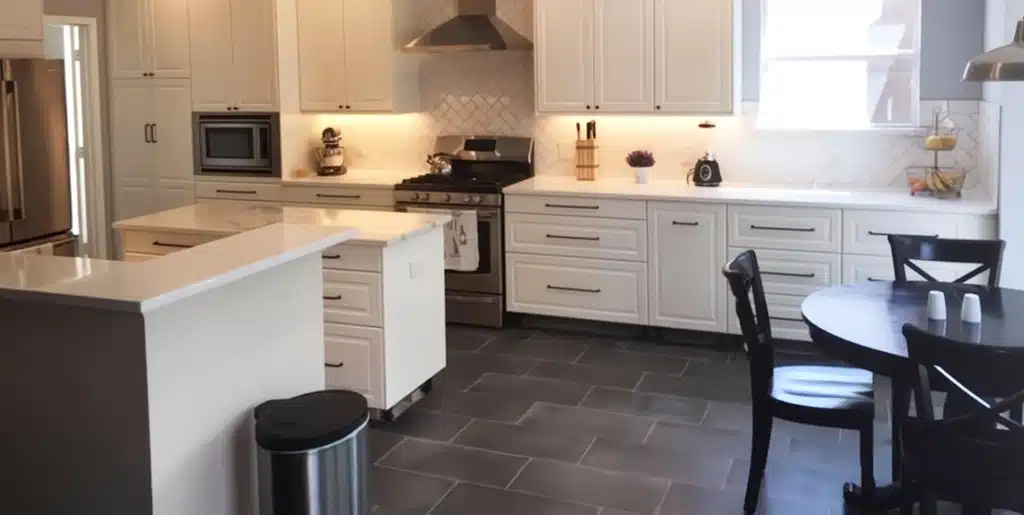
The carpet in your 1970s house has had its run. Or you own a condo, and the association has a rule about hard floors. Or a tenant just moved out of your rental, and the bedroom carpet left with them in spirit. You want the look of wood, a surface that stands up to daily life, and a price that makes sense. Laminate is on the list.
Laminate flooring is widely used in homes across Dallas because it offers durability and the appearance of traditional hardwood flooring. With a variety of finishes and textures available, laminate flooring can complement both modern and traditional interior designs. The Flooring & Remodeling Shop provides laminate flooring installation services for homeowners throughout Dallas who want to improve their interior flooring with durable materials and professional installation. We take out the old floor, prepare what is underneath, install the laminate over the right underlayment, and finish the trims, transitions and stairs.
By Dallas, we mean the City of Dallas itself. That includes North Dallas, the northern part of the city, generally north of Northwest Highway and reaching past LBJ Freeway into Far North Dallas. We serve the city from our showroom in Plano, at 2830 W. 15th St., Suite 1.
Is laminate the right floor for your rooms?
Laminate looks like wood but contains very little solid wood. Its top is a clear, hard melamine wear layer over a printed wood image. Under that sits a core of high-density fiberboard: compressed wood fibers and resin.
That build explains both its strength and its weak spot. The melamine surface resists scratches from pet claws, chair legs and moving boxes better than most wood finishes. The core, though, is wood fiber. If water gets into it through a seam and sits, it can swell, and swollen laminate does not shrink back.
Good fit: living rooms, bedrooms, halls, home offices and game rooms. Busy households and rentals, where scratches are the main enemy.
Think it through: kitchens. A quality water-resistant laminate works there if spills are wiped up promptly. If you want water off your worry list, luxury vinyl is the safer choice.
Choose something else: full bathrooms, laundry rooms and any room where standing water is routine. Luxury vinyl plank or tile handles those better, and we install both. One plan many owners use: laminate in the living areas and bedrooms, and vinyl or tile in the wet rooms, in matching tones.
Three checks before you choose a laminate
Two planks can look the same in a showroom and behave very differently in your home. These three checks decide it.
1. The AC rating: how hard the surface is. Laminate is rated for abrasion on the AC scale.
| Rating | Built for | Where it fits |
|---|---|---|
| AC3 | Heavy residential | Most rooms in a home |
| AC4 | General commercial | Entries, game rooms, large dogs, rental units |
| AC5 | Heavy commercial | More than a home needs |
Thickness is not the same thing. A 12 mm plank feels more solid underfoot than an 8 mm one, but it does not have a harder surface. A thin AC4 plank outwears a thick AC2 plank.
2. The water claim: what it actually covers. “Water-resistant” laminate has tighter edges and a treated surface that keep a spill out for a stated time. Some products are marketed as waterproof and carry longer topical-spill warranties. That is a real improvement. It is still a fiberboard core, and the claim covers water from above. Water from below, from a slab, a washer hose or a toilet seal, is a different problem. Read the warranty’s wording before you buy.
3. The underlayment: what goes under the planks. It does three jobs: cushioning, moisture control and sound. Over concrete, a vapor barrier is part of it, either a separate polyethylene sheet or an underlayment with one built in, as the laminate’s instructions require. In a condo, the underlayment carries most of the sound rating. If the plank has a pad attached, never add a second pad the manufacturer does not allow. A stacked pad makes the floor spongy and stresses the locking edges.
Call (972) 746-1575 · Request a written estimate
Laminate in an older Dallas house
The median home in the City of Dallas was built in 1981, and about one in three was built before 1970 (U.S. Census Bureau, American Community Survey 2020–2024 5-year estimates). If yours is one of them, what is under the carpet shapes the job.
If your house sits on a slab:
- Moisture first. Concrete releases moisture vapor. The vapor barrier goes down before the laminate.
- Flatness. Laminate floats: it clicks together and rests on the underlayment instead of being fastened down. Over a dip, it flexes with every step. That flexing causes the hollow sound, the clicking, and eventually broken locking edges. High spots and old tile mortar are ground down and low spots filled until the slab meets the manufacturer’s flatness tolerance.
- Room to move. Laminate expands and contracts with humidity. An expansion gap is left at every wall and fixed object, hidden under trim. Cabinets and kitchen islands never sit on top of a floating floor, because pinning it down causes buckling.
If your house has a crawl space (pier-and-beam):
- Fix squeaks and bounce first. A loose wood subfloor is fastened back to the joists. Bounce or sag can mean joist or pier problems, which should be evaluated and resolved before a new floor goes down.
- Flatten the subfloor. Humps at joists and dips between them telegraph through a floating floor just as a dip in concrete does.
- Mind the crawl space. Moisture reaches a floor from below. Flooring guidelines expect the crawl space to be ventilated, or its ground covered with a vapor retarder (NWFA installation guidelines). Follow the laminate’s instructions for wood subfloors, which can differ from its instructions for concrete.
What may be hiding under the carpet:
- Old vinyl tile or sheet vinyl. In homes built before the 1980s, vinyl flooring and the black adhesive under it can contain asbestos. The U.S. EPA advises leaving undamaged material alone. Have it tested by a qualified inspector before anyone scrapes or grinds it (EPA).
- Original hardwood. If you find solid wood boards, look before you cover them. Our Dallas hardwood page explains how to tell whether they are worth keeping.
- Parquet, small glued wood blocks. If yours is solid and well bonded, we can refinish it instead of covering or removing it.
Laminate in a Dallas condo or townhome
If someone lives below you, your floor is their ceiling. That is why many associations regulate hard flooring. Get the rules in writing before you choose a product, and look for these:
| Rule | What it means for laminate |
|---|---|
| A minimum sound rating (impact, IIC; sometimes airborne, STC) | The rating applies to the whole assembly: laminate, underlayment and the building’s floor. The product’s published test with a specific underlayment has to meet it |
| A required or approved underlayment | Use that one, or one with an equal or better tested rating |
| Approval before work starts | Often with the product and underlayment data sheets attached |
| Hard floors limited to certain rooms | Some buildings require carpet in bedrooms, or allow hard floors only on the ground floor |
| Work hours, elevator reservations, debris removal | Planned before the start date |
“Nobody checks.” Until the neighbor below complains. A floor that breaks the rules can be ordered out at the owner’s cost. The rules take ten minutes to read.
Over a concrete deck. In a mid-rise or high-rise, your floor is likely concrete. It needs the same three things as a slab: flatness, a vapor barrier where the instructions call for one, and the acoustic underlayment that meets your rule. Choose that underlayment for its tested rating, not its thickness.
At the entry door. The unit’s front door, the hallway outside and your floor inside often sit at fixed heights. Check the new floor’s total height, laminate plus underlayment, against the door and threshold before you order. Your written estimate spells out the materials, so you have the product details your association asks for.
Ground-floor townhome? You may face fewer sound rules, but approval and work hours can still apply.
Call (972) 746-1575 · Request a written estimate
Laminate in a Dallas rental property
More than half of the occupied homes in the City of Dallas are rented. Only about 42% are owner-occupied, and about four in ten are detached single-family houses (U.S. Census Bureau, ACS 2020–2024). If you own one of the rentals, flooring is a numbers decision: how long it lasts, how it looks in the listing photos, and what a fix costs when something goes wrong.
| Rental priority | What to choose |
|---|---|
| Survives tenants, pets and moves | An AC4 rating, in a textured, mid-tone color that hides scuffs |
| Spills and accidents | A water-resistant product, so a spill has time to be found and wiped up |
| Fewer trip edges | One continuous floor through connected rooms, with proper transitions at doorways |
| Easy fixes later | One product across the unit, plus spare boxes from the same production run kept in storage |
Laminate or luxury vinyl for a rental? Laminate’s surface is harder and resists scratches from furniture and moves. Luxury vinyl holds up well to tenant wear and tolerates water better. If the unit’s kitchen and baths are in the same plan, a common split is laminate in the living areas and bedrooms, and vinyl in the wet rooms.
Between tenants. A damaged plank on a click-lock floor can usually be unclicked from the nearest wall, or cut out, and replaced with a spare. That is why spare boxes from the original run matter: a newer batch may not match.
Stairs and transitions
Stairs. Laminate is never floated on stairs. Each piece is glued and fastened, with a stair nosing made for the product at the front edge. New flooring changes the height of the top and bottom steps, and building codes allow very little difference between steps. So the stairs are measured and planned before anything is glued down. If they need more than new surfaces, see our staircase remodeling work.
Transitions. Where laminate meets tile, carpet or another floor, a transition piece covers the expansion gap and evens out the height. Long runs and some doorways may need a transition joint so the floor can move. Planning these up front is what keeps a floating floor from peaking at the seams.
How a Dallas laminate project runs
- A consultation in your home, or at our Plano showroom, where you can compare samples.
- Measuring and inspection: every room and step, the slab or subfloor, door heights and transitions.
- A detailed written estimate that spells out removal, preparation, materials and transitions.
- Acclimation of the laminate in your conditioned home, following the manufacturer’s instructions.
- Removal of carpet, pad and tack strip or old flooring, hauled away. Suspect older layers are tested first by a qualified inspector.
- Preparation: grinding, leveling, squeak fixes, vapor barrier.
- Installation: a floating floor with expansion space; glued and fastened laminate on stairs.
- Trims and transitions, then a walkthrough of the finished floor with care instructions.
Keep the spare boxes and the product details. Your association, your rental file or a future buyer may ask for them.
Call (972) 746-1575 · Request a written estimate
What drives the cost
Every estimate is written for your rooms, because these factors move the price more than the plank alone:
- The product: AC rating, thickness, water resistance and realism.
- The underlayment, especially an acoustic pad with a tested rating.
- Removal: carpet is quick; tile and mortar take far longer.
- Preparation: grinding and leveling concrete, or fastening and flattening a wood subfloor.
- Older-home extras: testing of suspect layers by a qualified inspector.
- Building logistics in condos: elevator reservations, work hours, debris removal.
- Stairs, trims and transitions.
0% financing is available for qualified homeowners.
Why Dallas owners choose The Flooring & Remodeling Shop
- 4.6★ from 90+ Google reviews. Read client reviews and see finished work in our remodeling gallery.
- A showroom you can visit. Compare samples at 2830 W. 15th St., Suite 1, Plano, then have the floor installed by the same company.
- Six-time Best of Plano award winner (2015, 2016, 2017, 2018, 2020, 2023).
- 500+ flooring and remodeling projects completed under Sami’s leadership, and 60+ years combined experience.
- Certified General Contractor with $1 million in insurance coverage.
- In-house design and construction, so laminate, vinyl, tile and stairs can be planned as one project.
- Our installations include a written 1-year workmanship warranty.
- Family-owned & locally operated. Sami personally responds to inquiries within 24 hours.
Laminate questions from Dallas homeowners and landlords
Do you install laminate in North Dallas?
Yes. North Dallas is part of the City of Dallas, and we install laminate throughout the city from our Plano showroom.
Is laminate allowed in our condo?
It depends on your association. Many that allow it require an approved underlayment that meets a sound rating. Get the rules in writing first.
What sound rating do we need?
Whatever your association specifies. The rating applies to the laminate and underlayment together, as tested.
Can laminate go directly on concrete?
It floats over a vapor barrier and underlayment on flat, prepared concrete. It is not glued to the slab.
Can laminate go over our old floor?
Sometimes. Flat, well-bonded tile or sheet flooring can stay if the extra height works at doors and transitions. Carpet always comes up. Suspect older vinyl should be tested by a qualified inspector before anyone disturbs it.
Is laminate a good choice for a rental?
For living areas and bedrooms, yes: it resists scratches and goes in without adhesive. In kitchens and baths, luxury vinyl handles water better.
Can laminate go in the kitchen?
Yes, with a quality water-resistant product and spills wiped up promptly. If you would rather not think about water, choose luxury vinyl.
Why does some laminate sound hollow?
Usually because the floor underneath is not flat, or the underlayment is wrong. The planks flex and tap. Proper flattening and the right pad prevent it.
Can I see samples before I decide?
Yes. Visit our Plano showroom Monday to Friday 11 to 5 or Saturday 11 to 4, or start with a visit in your home.
Get a laminate estimate in Dallas
Tell us whether it is a house, condo, townhome or rental, what is on the floor now, and whether stairs are included. If there is an association, have its flooring rules handy. We will measure, check what is underneath, and give you a detailed written estimate.
Our showroom: 2830 W. 15th St., Suite 1, Plano, TX 75075. Monday–Friday 11–5, Saturday 11–4, Sunday closed.
Call (972) 746-1575 · Request an estimate
We typically respond within 24 hours.
Related: Laminate flooring in Plano · Laminate flooring in North Dallas · Hardwood flooring in Dallas · Luxury vinyl flooring
Ready to Transform Your Home?
Connect With Us Today
Call or Text (972) 746-1575
The Flooring & Remodeling Shop
2830 W. 15th St. Ste. 1, Plano, TX 75075
Serving Plano & North Dallas Suburbs