
Hardwood Flooring in Richardson, TX
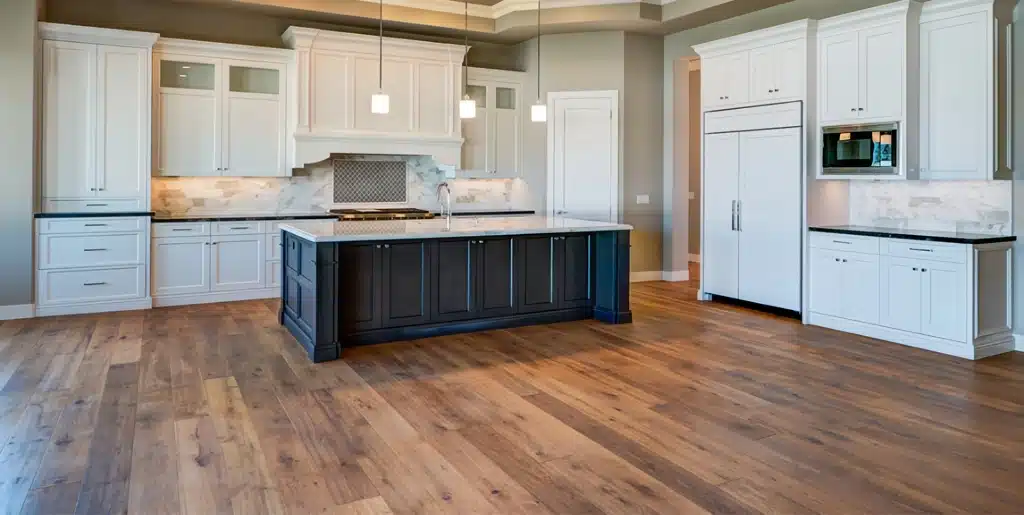
The house has great bones: long, low rooms, big windows, a brick fireplace. The floors are another story. Carpet laid over a slab poured before most of today’s building rules, maybe old vinyl or terrazzo underneath. You want hardwood that looks like it belongs in a 1960s or 1970s house, and you want it to stay flat on a fifty-year-old slab.
Hardwood is a natural flooring option that combines durability with timeless design, in living areas, bedrooms and halls. Richardson’s homes are older than those in Plano, Allen, McKinney or Frisco. The median home was built in 1986, and more than a third were built in the 1960s and 1970s alone (U.S. Census Bureau, ACS 2020–2024 5-year estimates). A floor going onto your older slab faces conditions a new home does not, and the style of your house shapes which wood looks right. This page covers both.
For species, solid vs engineered and North Texas humidity in general, see our hardwood flooring guide.
Older slabs and moisture: test, do not assume
Wood and moisture do not mix, and concrete always holds some moisture. With an older slab like yours there is an extra question: what is underneath.
- A vapor retarder may not be there. Current residential building codes require a vapor retarder, typically polyethylene sheeting, under slabs on the ground. Slabs poured decades ago were not always built that way, so more ground moisture can rise through the concrete.
- Test every time. The National Wood Flooring Association’s installation guidelines require concrete subfloors to be moisture tested before a wood floor is installed. In an older home, the test is the only way you can know.
- Add protection when the readings call for it. A moisture-control adhesive system or a vapor barrier over the slab protects an engineered floor. For solid hardwood, a plywood subfloor goes over a vapor retarder.
- Look for the sources. Grading that sends water toward your house, plumbing leaks under the slab or a damp flower bed against the wall all add moisture. Fix them before your floor goes in.
Leveling a fifty-year-old slab
Older slabs have had decades to move with North Texas clay soils. Before your hardwood goes in:
- Old floors come out: carpet and tack strip, tile and its mortar, or old vinyl. Very old vinyl tile and its adhesive may contain asbestos, so have it tested by a qualified inspector before it is disturbed (EPA guidance).
- Your slab is checked for flatness across each room, and high spots are ground and low spots filled. Wood floors bridge small dips but rock and squeak over larger ones.
- Cracks are assessed. Hairline, stable cracks are normal. Wide, offset or growing cracks, doors that stick, and sloping floors point to foundation movement that should be evaluated before you invest in a new floor.
Call (972) 746-1575 · Request an estimate
Choosing a floor that suits a 1960s–70s home
Ranch and mid-century homes have long, low rooms, plenty of windows, and often simple, clean-lined interiors. If your home is one of them, these floors tend to suit it:
- Narrow-strip oak (2¼″ to 3¼″) in a natural or medium finish: the classic floor of the period, and still a good match.
- Rift- and quartersawn white oak: straight, quiet grain that fits mid-century modern interiors.
- Medium-width engineered planks (5″ to 7″) in matte natural tones, for a more contemporary update.
- Parquet, kept as a period detail. If your home still has its original parquet, we can refinish it rather than tear it out; new parquet is an option where the old floor is gone.
Very wide, heavily rustic planks can look out of scale in low-ceilinged rooms. Lay samples on the floor in your own light before deciding.
Laying a straight floor in a room that is not square
Older houses settle, and many rooms are no longer perfectly square. A floor laid tight against a crooked wall will look crooked across your whole room. Instead:
- The layout starts from a straight reference line snapped across the room, usually along the longest, most visible run, not from the nearest wall.
- The rows run parallel to that line, so the boards look straight from the spots where you see them most.
- Any taper is absorbed at the edges, in the first and last rows, where baseboards cover it.
- Doorways are checked so a board does not end in a sliver at a threshold.
- Board direction between connected rooms is decided before installation, so your hallways and rooms flow together.
The same care applies to the joins with existing floors and to step-downs into sunken rooms. Our Richardson luxury vinyl page covers level changes and stair nosings.
Older house, crooked rooms? Call (972) 746-1575 · Request an estimate
Keeping the floor low in an older home
Over a slab, engineered hardwood glued or floated is the usual choice, and the floor height stays low, which matters if your older home has low door clearances and step-down rooms. Solid hardwood usually goes over plywood on a slab, which adds height; a few solid products are approved for glue-down. Both are available in every look above.
Call (972) 746-1575 · Request an estimate
How a Richardson hardwood installation runs
- Consultation: the rooms, the look you want, and samples in your light.
- Inspection: moisture readings, flatness, cracks, door heights and step-downs.
- Removal and slab preparation: old flooring out, grinding and leveling, moisture control as the readings require.
- Installation: glued, floated or nailed over plywood, with transitions and trims.
- Final walkthrough with care instructions.
What drives the cost of hardwood in an older Richardson home
- Removing old floors: carpet, tile and mortar, parquet or old vinyl (have suspect material tested first).
- Slab work: grinding, leveling, and moisture control as readings require.
- The product and method: engineered glued or floated, or solid over plywood.
- Layout complexity: out-of-square rooms, hallways and many doorways mean more cuts.
- Step-downs, stairs and transitions.
See our flooring installation cost guide for the general factors.
Who does the work
- In-house design and construction
- Certified General Contractor
- $1 million in insurance coverage
- 500+ flooring and remodeling projects completed under Sami’s leadership
- Six-time Best of Plano award winner (2015, 2016, 2017, 2018, 2020, 2023)
- 60+ years combined experience
- Our installations include a written 1-year workmanship warranty
- 0% financing available for qualified homeowners
You can see samples at our showroom, 2830 W. 15th St., Suite 1, Plano (Mon–Fri 11–5, Sat 11–4).
Hardwood questions from Richardson homeowners
Our rooms are not square. Will the new floor look crooked?
Not if it is laid from a straight reference line rather than from your walls. The small taper ends up at the edges, under the baseboards.
Is our old slab too damp for hardwood?
Only a moisture test can tell. If the readings are high, a moisture-control system or a different installation method protects your floor.
Can hardwood go over our old terrazzo or tile?
Generally the old hard floor is removed so the slab can be tested and leveled. Covering it raises your floor and hides problems.
Which hardwood suits a mid-century home?
Narrow-strip oak or straight-grained white oak in natural tones are the most period-appropriate; medium-width matte planks give a modern update.
Our floors slope. Can new hardwood fix that?
Leveling compounds handle small dips. A noticeable slope, sticking doors or widening cracks suggest foundation movement, which you should have evaluated first.
Is an older Richardson home a good candidate for hardwood at all?
Usually, yes. Your slab needs testing and leveling, and your rooms need careful layout, and older homes often suit hardwood well. If your home may already have original wood under the carpet, see our Dallas hardwood page.
Get a hardwood estimate in Richardson
Tell us when your home was built and what is on the floor now. We will measure the rooms and give you a detailed written estimate. Ask for a moisture test of the slab before any wood goes down.
Call (972) 746-1575 · Request an estimate
We typically respond within 24 hours.
Related: Luxury vinyl flooring in Richardson · Laminate flooring in Richardson · Wood-look tile in Richardson · Hardwood flooring guide
Ready to Transform Your Home?
Connect With Us Today
Call or Text (972) 746-1575
The Flooring & Remodeling Shop
2830 W. 15th St. Ste. 1, Plano, TX 75075
Serving Plano & North Dallas Suburbs